

How to Measure the Loudness of a User Problem
The bigger your business gets, the more complaints you get about your business. That is a fact. You can see it everywhere: the bigger a company gets, the more its PR team grows.
Complaints are inevitable. They are there whether you want them or not, and it is impossible to avoid them. Sometimes they are rude, sometimes they are angry, and sometimes they are not fair. Sometimes they are actually quiet and get zero impressions.
Content gets the most impressions when it has the most emotion integrated into it. Sometimes these emotions bury the real facts and rig the judgment process. A single angry user with a megaphone looks like a crisis, but it actually might just be an outlier. On the contrary, a user who found a quiet way to bypass your system and is happy about it is a real structural problem that needs to be fixed.
To build a reliable product roadmap, you have to stop reacting to the most dramatic posts. You need a system to measure the actual "loudness" of a problem using volume, resonance, and velocity.
I am an SEO Specialist who constantly tackles content ideas and prioritizes what actually matters. In this article, I want to talk about why and how to measure the loudness of a user problem.
This article is the continuation of the previous post about the complaint economy, so I highly recommend you take a look at that article first.
The Squeaky Wheel Fallacy
Let's talk about a real paradox here.
Running a business is a serious thing, and emotions should rarely be the main reason we make decisions.
On the other hand, forums and community websites like Reddit are a gold mine of complaints and ideas for our business. However, they are still social media platforms. They are made of algorithms. Algorithms show the most interesting and the most emotional posts at the top of the feed.
If you only look at the top posts in a subreddit, you are letting the algorithm dictate your research. You miss the quiet, boring problems that pop up in the community every single day.
The Three Pillars of a Loud Problem
To filter out the algorithm bias, we have to look at three main pillars to determine if a problem is actually loud and worth our attention.
1. Volume This is simply the headcount. How many unique threads are talking about the exact same issue? Ten different posts with five upvotes each are usually a stronger market signal than one highly emotional viral post with fifty upvotes. Volume proves the problem is widespread.
2. Resonance This is the engagement factor. Are people upvoting the complaint and jumping into the discussion? High resonance happens when the comment sections are full of users agreeing and sharing their own variations of the problem. It shows the community deeply cares about the issue.
3. Velocity This is the growth rate over time. Is this a brand new problem, or an old one that is suddenly spiking? If you see a sudden cluster of complaints about a specific bug over a short period, that velocity tells you the problem is urgent and expanding quickly.
Grouping the Noise into Core Intents
Sometimes vocabulary is a massive problem. Users rarely use the exact same words to describe a problem. One person calls it a "glitch," another calls it a "crash," and someone else says "the screen froze."
You should not expect everyone to use the same jargon as you do. You are an expert, but most of the users are not. That is why manually searching through thousands of words with a few static keywords does not really work. We need a better approach.
You have to group all these different phrasing variations into one core intent. If you just search for the word "crash," you will miscalculate the true size of the problem because you missed everyone who typed "froze."
That is why in NicheEngine, we use embeddings to group and cluster the problems and tag them by one single name. This is a great approach which is frequently used by major social media platforms for content feeds, but it has rarely been used specifically for finding and categorizing user pain points.
Building a Scoring System
When it comes to scoring these problems, you do not need an overly complicated framework.
The most effective way to score a pain point is by looking at the aggregate data of the cluster. Once the problems are grouped together under one core intent, you simply look at how many individual posts are talking about that specific issue. Then, you combine the total number of upvotes and comments across all those posts.
This gives you a single, undeniable metric. By aggregating the total post count with the sum of all engagement, you get a very clear priority score. You instantly see which clustered problem has the highest combined volume and resonance. It takes the guesswork out of prioritization, letting you see exactly which issues are the loudest and demand your immediate attention.
Conclusion
Gut feelings and manual scrolling will always lead to biased product decisions. You need structured data to know what to build next. Stop letting social media algorithms dictate your product roadmap. I suggest you try NicheEngine to see exactly how your industry is dealing with its biggest problems and point points and start prioritizing the complaints that actually matter.
Recommended next
Keep exploring
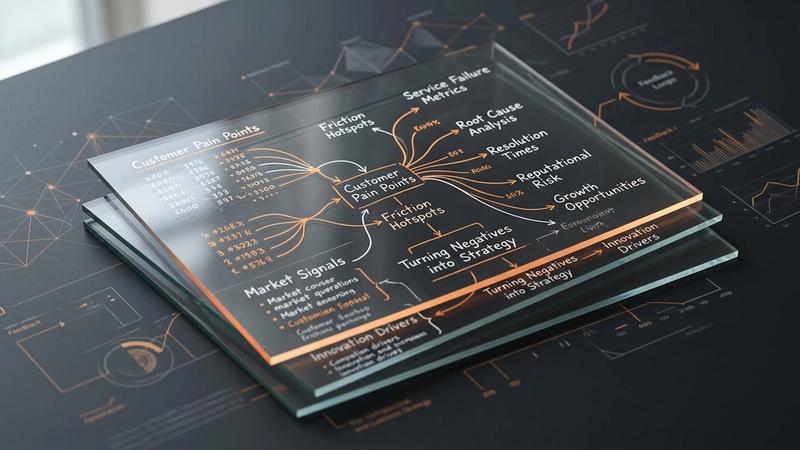
The Complaint Economy: Turning Online Friction Into Business Strategy
Complaints are one of the most valuable data you have. Learn how to skip endless scrolling and turn messy Reddit friction into the structured product roadmap inside of NicheEngine.

Pain Point definition: What Actually Qualifies as a Pain Point
The phrase pain point has become an empty marketing buzzword. In this article we talk about what actually is a pain point and how you can qualify a complaint as a real problem worth solving.